




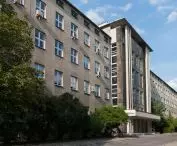
The demolition of the Chemistry Department building at the Łódź University of Technology, located at 116 Stefana Żeromskiego Street, has been halted! Following a protest campaign initiated by Maria Nowakowska, the Łódź Branch of SARP issued a statement, and the Provincial Office for the Protection of Historic Monuments in Łódź began the process of listing the modernist building on the Łódź University of Technology campus in the register of historic monuments. Will the modernist renovation designed by Jan Reda be saved?
As a reminder, at the end of June, a protest campaign began against plans to demolish the building of the Faculty of Chemistry at the Lodz University of Technology, initiated by Maria Nowakowska, an art historian and architecture advocate known online as Maria od Detalu. Over two thousand people signed the protest letter, and the National Institute of Architecture and Urban Planning and the publishing house Architektura&Biznes, among others, joined the campaign. In response to the demolition company’s dismantling of the building’s interiors, the Łódź Cała Naprzód Association and the Łódź Branch of the Society for the Preservation of Historic Monuments submitted a request to the Provincial Conservator of Historic Monuments in Łódź to initiate the procedure for entering the modernist building from the late 1940s.
Will the building of the Faculty of Chemistry at the Łódź University of Technology become a historic monument?
On July 8, 2026, the Provincial Office for the Protection of Historic Monuments in Łódź announced on its social media profile that it had initiated proceedings to list the building of the Faculty of Chemistry at the Łódź University of Technology in the register of historic monuments.
In light of numerous press articles and media statements regarding applications submitted to the Łódź Provincial Conservator of Monuments by civic organizations, industry associations, and individuals interested in the protection of cultural heritage, regarding the placement of the building of the Department of General Chemistry at the Lodz University of Technology—located in Lodz at ul. 116 Żeromskiego Street, I would like to inform you that, in response to a request from the Łódź Branch of the Society for the Preservation of Historical Monuments, by a decision dated July 7 of this year, proceedings have been initiated to enter the aforementioned building into the register of immovable monuments of the Łódź Province.
— the announcement reads.
The initiation of the registration procedure means that all demolition work must be suspended until the Łódź Provincial Conservator of Historic Monuments makes a final decision. The authorities of the Łódź University of Technology have not yet officially commented on this information.
Statement from the Łódź Branch of SARP
Meanwhile, the Łódź Branch of SARP has expressed its position on the plans to demolish the building at 116 Stefana Żeromskiego Street in Łódź. In a letter signed by Jakub Krzysztofik, President of the Board of the Łódź Branch of SARP, and Karolina Taczalska, Vice President of the Board of the Łódź Branch of SARP, we read:
Statement by the SARP Łódź Branch on the planned demolition of the former Chemistry Department building of the Łódź University of Technology
The Łódź Branch of the Association of Polish Architects is closely following the discussion regarding the planned demolition of the building of the former Department of Chemistry at the Łódź University of Technology.
We do not take a position on the university’s investment decision itself. However, we believe that this matter has significance beyond a single investment project and touches on fundamental issues related to the protection of architectural heritage, environmental responsibility, and standards for conducting contemporary investment processes.
The building is a significant part of the history of the development of the Lodz University of Technology and the city’s postwar reconstruction. It is an example of the adaptation of former industrial buildings to new academic functions—a process that is now recognized as one of the most important tools for sustainable design and heritage preservation. In the literature on the architecture of Łódź, the building has been cited as a valuable example of postwar architecture and an element that shapes the campus’s identity. Research by Prof. Joanna Olenderek also highlighted the preservation of original fixtures and architectural details, such as woodwork, balustrades, floors, and elements of the lecture halls. A similar position has been expressed in recent days by, among others, architect and architectural historian Dr. Błażej Ciarkowski and architect Piotr Biliński, who pointed to the possibility of seeking design solutions based on the adaptation and continuation of the existing structure.
At the same time, we view with concern reports that the documentation prepared prior to demolition was to include only a structural and construction inventory, without complete architectural documentation of the interiors and their furnishings, despite concurrent reports of the preservation of historical details. In our view, regardless of the final investment decisions, comprehensive documentation of the building’s architectural values should be the standard procedure for buildings of documented significance to the city’s architectural history.
Equally important is the environmental dimension of this decision. Contemporary architectural practice and European trends in construction clearly indicate that the most sustainable building is often one that already exists. The adaptation of existing structures allows for the preservation of the so-called embodied carbon associated with materials and construction, and reduces emissions resulting from demolition, waste transport, and the production of new building materials.
Therefore, we believe that when making decisions regarding the demolition of large-scale structures, it should be standard practice to conduct and publicly present:
- a comparative analysis covering the possibility of adaptation and modernization,
- an environmental cost analysis, including an assessment of the carbon footprint throughout the building’s life cycle (Life Cycle Assessment—LCA),
- a material balance and an assessment of the potential for reusing building components,
- an assessment of historical and architectural value, along with documentation of preserved details.
The discussion regarding the future of this building is also important because it concerns a technical university that educates future architects, urban planners, and engineers. The academic community plays a special role in setting standards for responsible design, heritage preservation, and the implementation of circular economy principles.
The Łódź Branch of SARP does not prejudge whether, in this specific case, the only appropriate solution is to preserve the building or to demolish it. However, we believe that decisions regarding structures with documented historical and architectural value should be preceded by a transparent process based on expert knowledge, thorough technical, economic, and environmental analyses, and comprehensive documentation of the structure’s cultural value.
We hope that, regardless of the final outcome, this case will serve as a catalyst for developing best practices regarding the treatment of 20th-century architecture—practices that simultaneously take into account the needs of development, heritage preservation, and climate goals.
As the Association of Polish Architects, we declare our readiness to participate in a substantive debate on standards for the protection of contemporary architectural heritage and the sustainable development of the built environment.